The Northern Edge of Caesar’s Belt
My destination is where the treeline meets with the Cole Henley Road, not too far south of Cannon Heath Farm. It was just to the east of there that Holly and the other emissaries to Efrafa crossed on their way south. Whilst I’m not going that far, I will find my way to the spinney where the rabbits listen to Dandelion tell the story of El-ahrairah and the Black Rabbit of Inlé.
The northern flank of Caesar’s Belt, facing west, November 2025.
That annoying, all-soaking, fine November morning mist fills the bottom of the lane between Cole Henley and Ashley Warren. A steady breeze cuts in from the north west, over Great Litchfield Down; the slope and its tree-line concealing Beacon Hill behind it. I pull my hood up though the wind penetrates the untreated cotton, numbing my ears and instigating a deep headache of the type that invariably develops into a migraine.
My lower quarter is already soaked. Heading uphill, my socks squelch inside my sodden canvas shoes. The grass isn’t long, but my trousers wick the moisture from the mist and overnight rain. I came badly prepared and I am on a bridleway without a path, without gravel, tarmac or concrete. There is a track, but behind an ironically rabbit-proof wire fence, topped with the obligatory ribbon of barbed wire. A path for someone who probably rarely comes here and, even then, seldom uses it. It runs along the northern flank of Caesar’s Belt.

The northern flank of Caesar’s Belt, November 2025.
As Richard Adams details in Watership Down, Caesar’s Belt is a strip of woodland that follows part of the route of the old Port Way, a Roman road that spanned the distance between Silchester, near Basingstoke, Hampshire, and Old Sarum, Wiltshire. It’s an important landscape feature in the novel, forming part of the Down rabbits’ two missions to Efrafa.
The wood’s features are best described by Holly (Chapter Twenty-Seven, ‘You Can’t Imagine it Unless You’ve been There’) following his unsuccessful doe-finding expedition:
Well, before ni-Frith,’ went on Holly, ‘the track brought us to a long, thin wood running right across the way we were going. These downland woods are queer, aren’t they? This was no thicker than the [Watership Down beech hanger] above us now, but it stretched as far as we could see either way, in a dead straight line. I don’t like straight lines: men make them.
And it does stretch on in a perfectly straight line. Uphill in front of me, behind me down to the lane and up the other side of the valley.

The stile.
I head on up the steep incline, keeping the Belt to my right and open fields to the left. My destination is where the treeline meets with the Cole Henley Road, not too far south of Cannon Heath Farm. It was just to the east of there that Holly and the other emissaries to Efrafa crossed on their way south. Whilst I’m not going that far, I will find my way to the spinney where the rabbits listen to Dandelion tell the story of El-ahrairah and the Black Rabbit of Inlé. The same place where, shortly after, Bigwig bolts to distract an approaching fox and inadvertently lures it upon an Efrafan patrol within the Belt.
A short distance on, where the hill levels out, I come to a stile in the fence. Over the barrier, you can pass through the Belt and see where Hazel’s successful raiders approached the Belt on their way back from Efrafa. That must wait for another day. I take in deep breaths amidst the stifling, cold wind. My lungs are still strained by the remnants of Covid and each inhale seems harsher than the last. Something chatters in the Belt, to the left of the stile: just ahead of me. Wings flutter, pheasants croak, two males ungracefully flap over the fence and into the recently drilled cereal field. Two … three more calls from between the trees. I wait for the bark of a fox but it never comes.

Facing west, where the fields become a visible track.

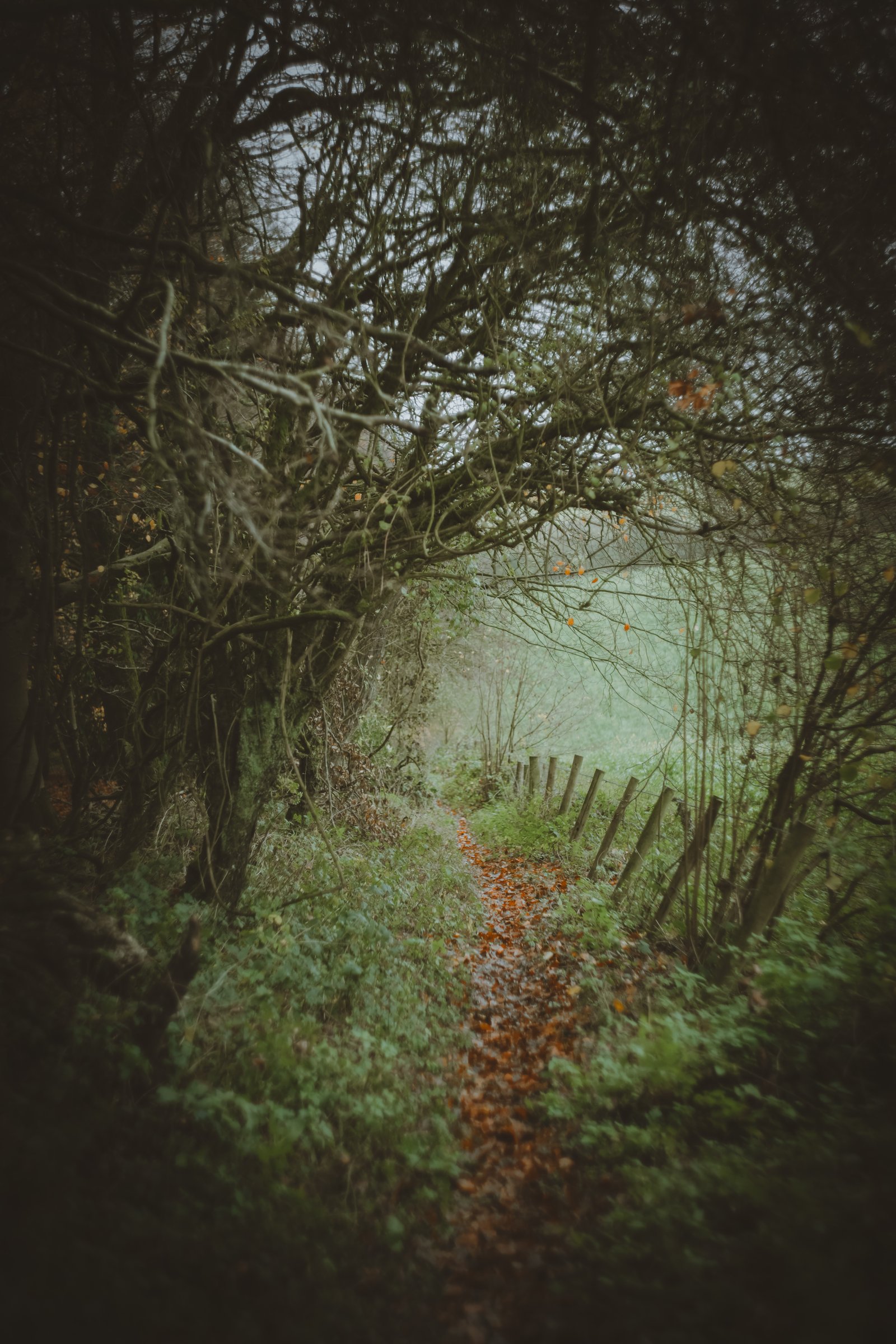
Tree tunnel, the Belt and spinney are to my right.
I distract myself from the cold numbing my feet and lower legs by studying the different tree types as I move up the next rise. It’s not something I’m good at and I find it hard to differentiate between many of them. Common beech trees seem to dominate (or at least they do in my mind) but there are definitely hawthorn and blackthorn along the edges of the belt, still holding their fruit.
Two thirds of the way into my walk, the path takes on a more conventional form and I am funnelled between two wire fences. Overhanging trees from the Belt reach over to touch the wooden fence posts, creating a tunnel. Underfoot, the carpet of leaves is slippery and almost takes me down. Whilst stumbling, I notice the field to my left. Full of autumn-flowering charlock, it is dominated by a deep, high-sided combe. Gawping, I fail to notice how the fence directly along the Belt’s edge has gone.

Rabbit level view going into Caesar’s Belt.

Passing into the spinney.
Immediately north of the spinney I stop and use Google Maps to check my location. Impressed by my fortunate timing and now noticing the long gap in the fence, I scramble up the short bank into the Belt. Unexpectedly, I soon find myself before a well defined, wheel-rutted track. I quickly realise that this is the track along the southern side of Caesar’s Belt, with the spinney essentially a separate woodland on the other side. The purpose of this track is immediately obvious: blue game bird feeders are dotted around, even if there are none of those most unfortunate birds.
Slowly, I pick my way through the dense trees of the spinney, coming out onto its southern edge. I can just about see down into the combe, where Fiver spotted the approaching fox. Today, the combe is overgrown with thousands upon thousands of weeds, each bearing leaves heavy with cold, clear raindrops. I look but don’t touch, before passing back through the trees.
A group of runners approach from my right as I step back out from Caesar’s Belt onto the bridleway. I shuffle back for them, watching as the man third in line slides awkwardly on wet leaves. He curses and slows to limp for a few steps, continuing uncomfortably. It is tempting to follow them back from where I came, and in a short while I will do so, but first I must continue to my destination.
All along this stretch of the Belt, Hazel kept his rabbits under the trees as they passed through on their way to Efrafa. I am in no rush, peering through the trees to see just what they would have encountered here.
Finally, from nowhere, I come to a north-south leading track at the very edge of the wood before Caesar’s Belt hugs the Cole Henley Road. I turn around, heading west to retrace my footsteps.
It is a slow, cold and wet walk back. The runners are long gone and nobody else is to be seen or heard. The only sound of humanity I catch is the occasional plane flying high within the dense layer of deep grey cloud. The wind drops and even Caesar’s Belt is completely quiet. It is a peculiar, almost post-apocalyptic atmosphere. Out here, following this long, eerie corridor of trees, I am completely alone.
I put my head down and walk, with the first signs of that migraine starting to emerge.
