On the Real Watership Down
Hazel’s Ditch and the Trees
As the sun sank lower and touched the edge of the cloud-belt on the horizon, Hazel came out from under the branches and looked carefully round the lower slope. Then he stared upwards over the ant-hills, to the open down rising above. Fiver and Acorn followed him out and fell to nibbling at a patch of sainfoin. It was new to them, but they did not need to be told that it was good and it raised their spirits.
Hazel turned back and joined them among the big, rosy-veined, magenta flower-spikes.
‘Fiver,’ he said, ‘let me get this right. You want us to climb up this place, however far it is, and find shelter on the top. Is that it?’
‘Yes, Hazel.’
Chapter Eighteen—Watership Down
Having bravely made their way south from Cowslip’s Warren (Chapter Eighteen, Watership Down) the rabbits grab some rest under a line of spindle trees at the base of Watership Down’s northern slope.
Although Richard Adams never plays up the importance of this thin wood, later describing it as ‘a belt of hawthorn and dogwood’ (Chapter Forty Five, Nuthanger Farm Again), it is a notable feature in the novel. Here the settlers come across a ‘short length of old, overgrown ditch’ which is identified as good cover should they need to bolt (Chapter Nineteen, Fear in the Dark). This safe place subsequently becomes a refuge for Hazel in Chapter Twenty Eight, At the Foot of the Hill, after he is shot at Nuthanger Farm.
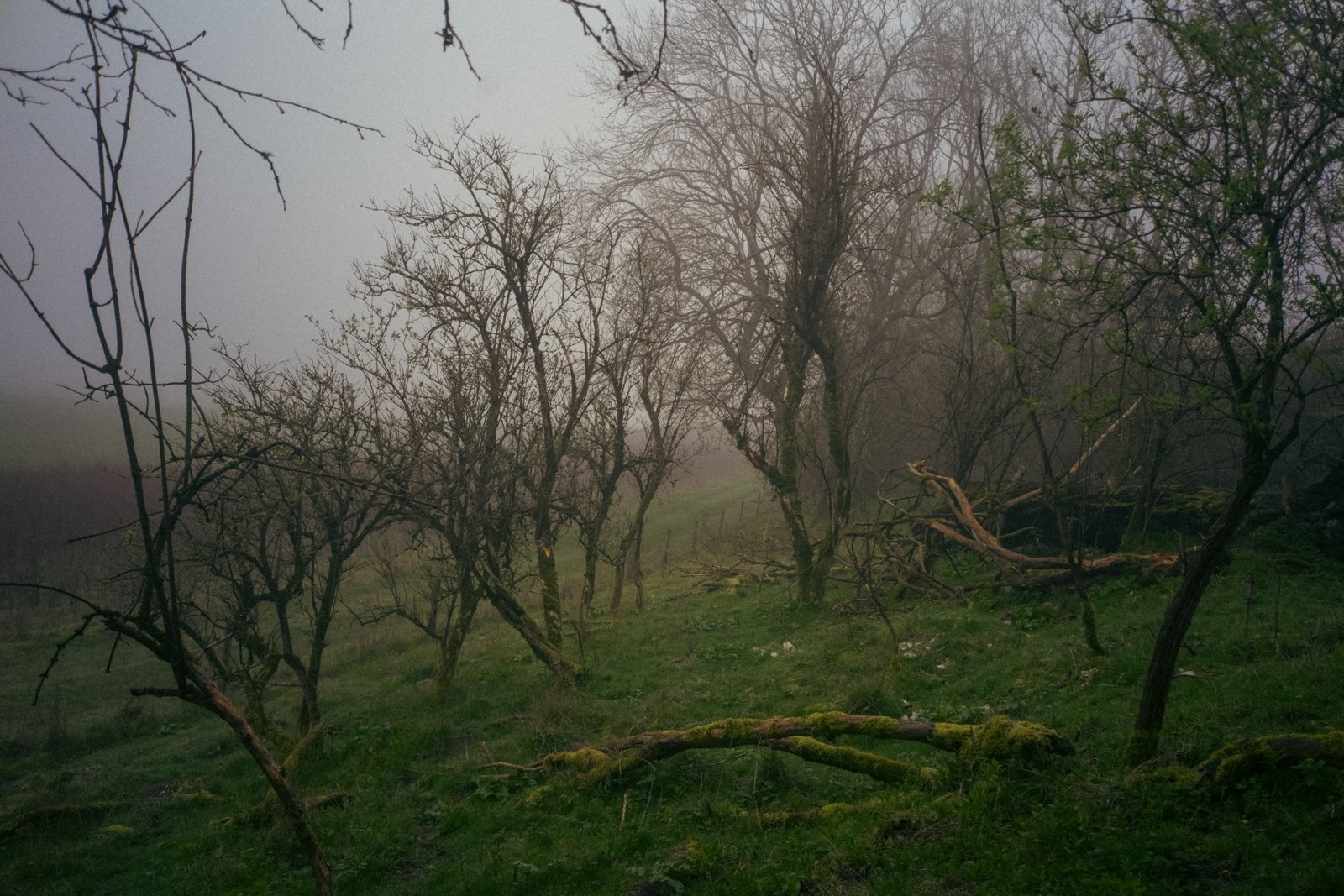
Looking down into the ‘great field’ below the Down.
Looking at old maps and aerial images of the tree belt, little has changed in terms of its size. Although the westernmost portion is fenced off to contain game birds the remainder lacks a clear boundary. Assuming that the rest was open access land (erroneously, as it turns out, so if anyone from the Sydmonton Estate is reading this, please accept my apologies!), I wandered down in amongst the trees on a foggy morning in early March 2026.
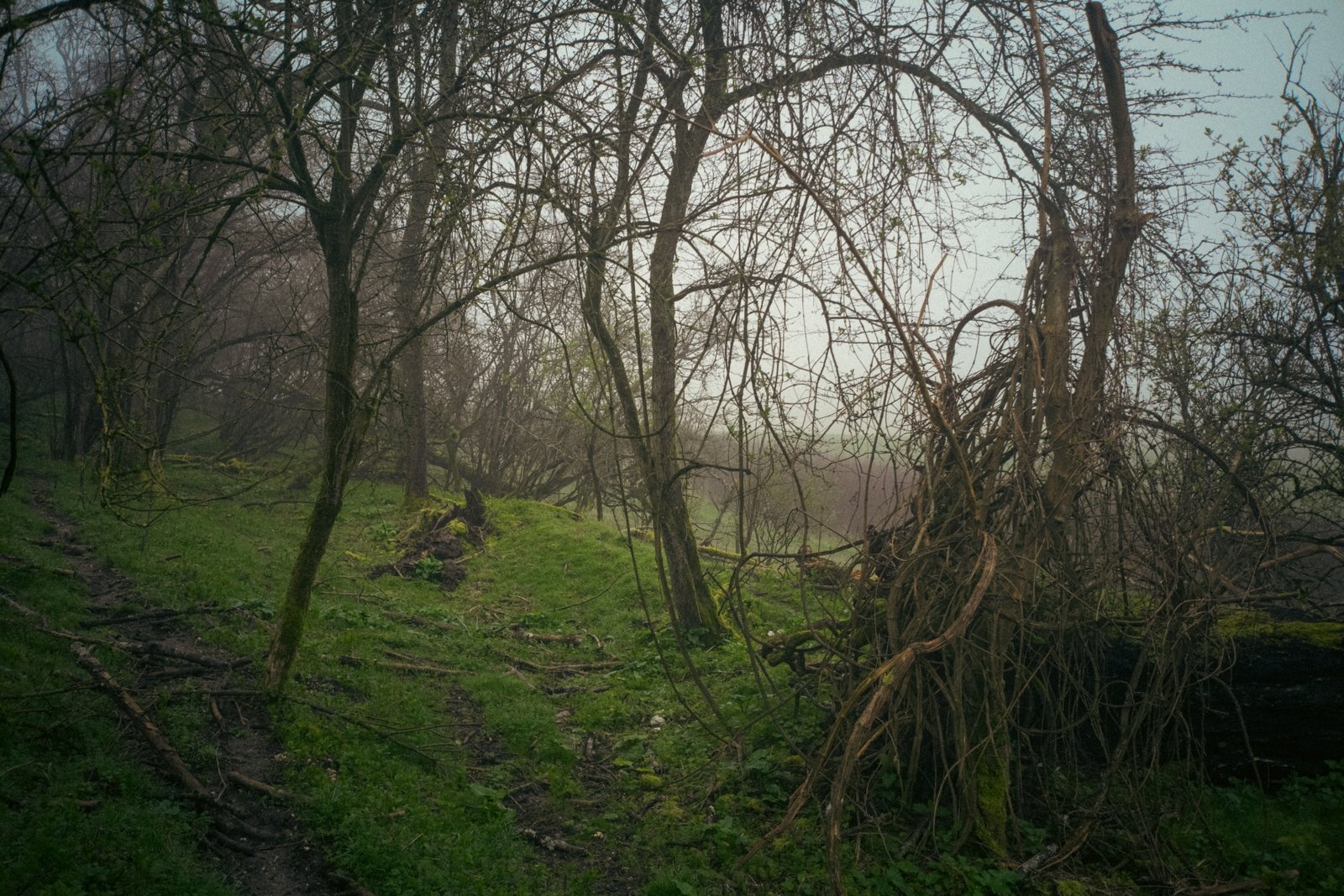
This was the first time I had been up close to the trees without seeing them adorned with their leaves and I was fascinated by the strange, barren eeriness of the scene. Fallen branches and twigs littered the weirdly vivid grass alongside entire trees that had toppled over, presumably due to soil erosion on the slope.
Naturally, I couldn’t resist the opportunity to try and seek out any signs of Hazel’s ditch. In Episode 207 of The Watership Down Podcast, Newell Fisher identifies two possible sites. The first of these is no more than ten metres above the wire fence at the base of the woodland, the second a bit higher up the hillside. My personal belief is that the first of these is the more likely candidate:
In Chapter Nineteen, Hazel, Dandelion and Bigwig are in the ditch and disturbed by ‘dreadful, squealing’ sounds in the darkness. Hazel investigates, being unable to see much for ‘a few moments’ until he realises the wailing is coming from ‘the hedge along the side of the field.’ Hazel immediately ‘turned towards the sound and in a few moments made out, under a clump of hemlock, the hunched shape of a rabbit.’ Presumably, the hedge stood where the wire fence at the base of the woods can now be found.
With a little searching I was able to find what may have been the ditch: an indentation flanked on its lower side by a ridge that appears something other than a natural formation. Am I guilty of wishful thinking? Possibly, but with no more obvious alternatives, this is one of those instances where we can only guess at the precise location Richard Adams wrote of.