Greenham Common: Part One
RAF Greenham Common was constructed on the heathland site of the former Greenham Lodge Estate and opened in 1942. Its original purpose was to serve as a satellite station for the bomber training unit based at nearby Aldermaston. This never materialised. Instead, the first occupants were the United States Army Air Force; beginning a long association between this small corner of west Berkshire and American forces.
Looking north from the top of Watership Down, up and over Nuthanger Farm, the most noticeable feature in the middle distance is a sizable cluster of light coloured industrial units some four miles away. These modern structures were not present when Richard Adams wrote Watership Down. Instead, the buildings that previously stood on the site were enclosed behind security fencing and barbed wire. They served as the main accommodation, technical and administrative units for United States Air Force (USAF) personnel on the southern flank of the infamous RAF Greenham Common airbase.
I’ve pieced together two articles on the base. This one shares a very basic overview of its history; the second, to follow next, concerns its appearance and use today.
RAF Greenham Common was constructed on the heathland site of the former Greenham Lodge Estate and opened in 1942. Its original purpose was to serve as a satellite station for the bomber training unit based at nearby Aldermaston. This never materialised. Instead, the first occupants were the United States Army Air Force; beginning a long association between this small corner of west Berkshire and American forces: General Eisenhower gave his famous ‘Eyes of the world’ speech at Greenham just prior to the departure of troop-carrying planes and gliders participating in the D-Day operation, and post-war, B-47 bombers from Strategic Air Command (SAC) were based here. Then, in 1980, Margaret Thatcher’s British Government permitted the United States Air Force (USAF) to base 96 BGM-109G ‘Gryphon’ ground launched cruise missiles (GLCMs) at Greenham Common, alongside another 64 at RAF Molesworth in Cambridgeshire. Had they ever needed to be used, these missiles would have been dispersed in clusters of four, each batch on a launcher towed by an 8×8 wheel off-road capable truck. They would pitch up at pre-surveyed sites within a 100 mile radius and await their orders.
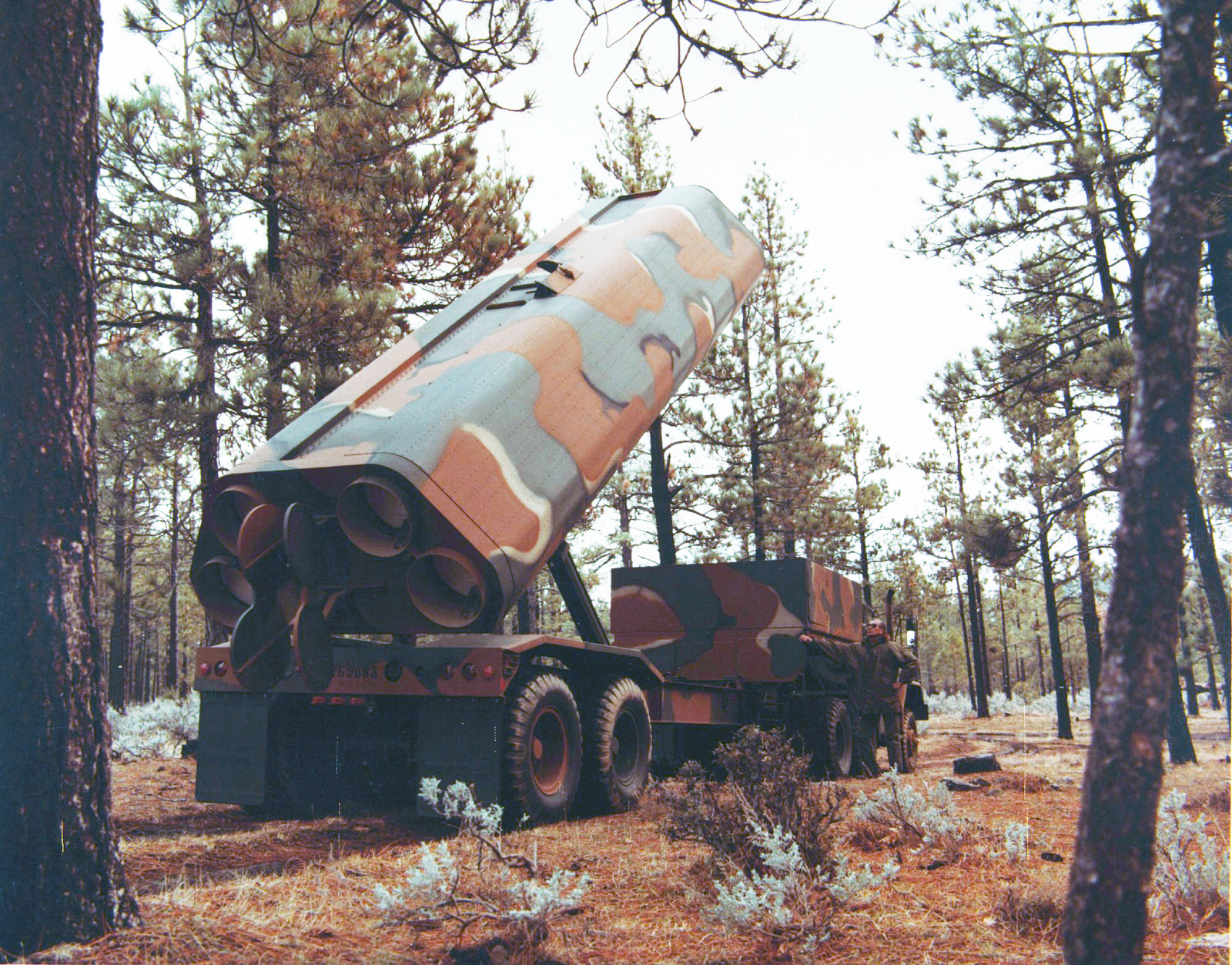
GLCMs ready to launch. The camouflage scheme is not consistent with the one that would have been employed on the launchers in Britain. Public domain image.
Thatcher’s decision to house part of America’s nuclear arsenal in England was not universally appreciated. Some correctly figured that the presence of the missiles would make both Greenham and Molesworth, alongside their likely launch sites, targets in their own right. (In retrospect, such a viewpoint may seem naive in the context of Duncan Campbell’s 1983 book War Plan UK in which he reports on Square Leg, a home defence exercise held by the British Government in September 1980. Target plotting suggests the authorities had already envisaged much of southern central England to become an irradiated wasteland in the event of war.) Others pointed out that the GLCMs may not have been a retaliatory weapon. Though slow moving, they were capable of travelling at an extremely low altitude to evade radar detection and could potentially deliver a devastating first strike against Soviet military targets. It is not hard to understand why the Soviet leadership became increasingly nervous as to American intentions.
A 1983 report by Thames Television on cruise missiles at Greenham Common. It features the town of Whitchurch, later to be home to Richard Adams.
Though the first missiles weren’t expected until 1983, the Welsh group Women For Life On Earth began a march from Cardiff to Greenham Common in August 1981. Upon their arrival in early September, these women began a near exclusively female protest that would last almost twenty years.
Across these two decades, thousands of women would lend their time and support to the cause of nuclear disarmament, spending a day, week, months or years within an array of tents and tarpaulins in various camps dotted around the base perimeter. Life there was tough: without power, running water and plumbed toilet facilities, and being at constant risk of heavy handed treatment from police, local vigilantes and bailiffs, the dedication of these protestors was staggering. They staged actions which, according to protestor Jill Raymond, included, ‘embracing the base [joining hands around the perimeter fence], invading dressed as teddy bears for a picnic, occupying the sentry box (which included answering their phone), leaving goddess figures in the hangar, dancing on the silos, putting a hex on the electronic gate, distributing Christmas cards…’
An article hosted at Air and Space Forces Magazine highlights the annoyance caused by the protesters to American personnel. It notes they would sometimes ‘breach exterior defenses and reach logistics buildings. They always seemed to know when GLCM units would be leaving the base to practice launch deployments on Salisbury Plain.’
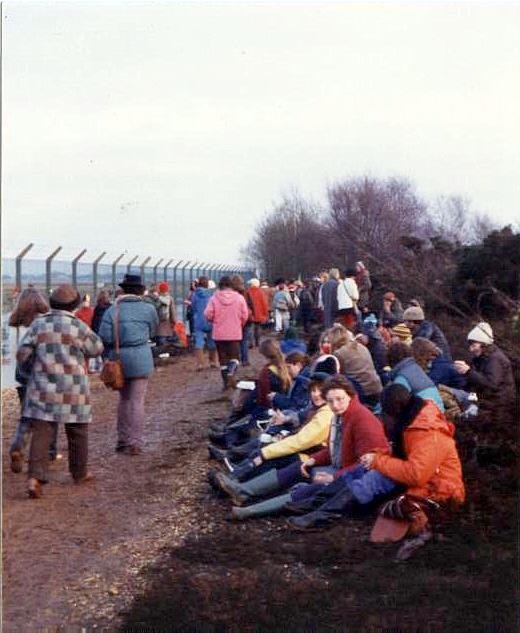
Greenham Common women’s protest 1982, gathering around the base. Photograph by Ceridwen.
The presence of the female protesters reflected the spirit of the times and growing anti-nuclear sentiment across western Europe. Not only did the Greenham women oppose the stationing of the GLCMs at the base, their feminist arm saw (not unreasonably, it should be added) the missiles as a symbol of the male dominated, war minded military-political-industrial triad. As a former Greenham protester said in a 2017 interview for The Guardian:
‘By February 1982 it had been decided that this was a women-only protest – and this was crucial: a woman’s place was not in the home, but at a protest. Women could use their identity as carers and mothers to say, this is about the future safety of our children. We weaponised traditional notions of femininity.
‘Symbolically and strategically this made Greenham special. By casting the political area as male, the women’s very presence became a clear and problematic intrusion.’
The end of the Cold War and the 1988 signing of the Intermediate-Range Nuclear Forces Treaty between Russia and the Soviet Union marked the beginning of the end for the base. By the end of 1991, the GLCMs had been removed and, in the following year, RAF Greenham Common was closed for good.
Nonetheless, a smattering of protesters stayed outside the perimeter fence until the last of it was finally pulled down in September 2000. By then, the former accommodation and administrative structures on site had been demolished to make way for the previously mentioned units of Greenham Business Park. Much of the remainder of the site had also been re-opened for public use, being incorporated into a 1100 acre area of heathland and woodland designated as Greenham and Crookham Commons. More on that in Part Two.